


|
Galvestonians place high regard on education as the means of improving their city and its residents. The city has a strong public school system and eight private schools. Each year, high school graduates of Ball High School and O’Connell High School, a private Catholic school are accepted by the top colleges and universities in the state. Some graduates continue their education on Galveston Island at one of three institutions of higher learning - Galveston College, The University of Texas Medical Branch or Texas A&M University at Galveston.
Public Schools
Established in 1884, Galveston's public schools were initially governed by the City of Galveston until 1949 when the Texas Legislature created the Galveston Independent School District for the express purpose of providing a free public education to the children of the community.
The district serves approximately 8,400 students, including the Island and Bolivar Peninsula, and operates one high school, three middle schools, seven elementary schools and one Pre-K through eighth grade campus on Bolivar Peninsula. The district also offers alternative education programs and accelerated instruction programs for elementary, middle and high school students. The Accelerated Instruction Model or AIM program allows students to catch up to their grade level or in the case of high school allows students to obtain their high school credits at their own pace to graduate. The Ball High School Class of 2006 included 97 AIM students.
GISD’s student body is ethnically and culturally diverse. Approximately 41 percent is Hispanic, 31 percent is African American, and 28 percent is white or of other races. The district employs more than 1,200 people and the annual operating budget for the 2006-2007 school year is $79,790,000.
During the 2003-2004 school year, GISD opened student enrollment to non-Galveston residents who work within the boundaries of the school district. The district is now collaborating with HeadStart to serve four-year-olds in a full-day pre-kindergarten program.
GISD offers a variety of programs for students. Services include dual credit courses with Galveston College, a nationally recognized Advanced Placement program, bilingual and English as a Second Language curriculum, a two-way immersion program for elementary students learning English and learning Spanish, special education programs, an Accelerated Instruction Model (AIM) program, preschool program for children with disabilities, student assistance program and tech prep initiatives with Galveston College.
The Texas Education Agency recognized ten GISD campuses with Gold Performance Acknowledgements for improvements on the Texas Assessment of Knowledge and Skills (TAKS). GISD made improvements in four of the five TAKS testing areas. Oppe and Parker Elementary Schools are “Recognized” campuses.
In an effort to improve student performance, GISD is implementing best practices from top performing schools to improve student achievement such as curriculum based assessments and vertically and horizontally aligned curriculum.
Ball High School had 239 students take 529 Advanced Placement (AP) exams for college credit, more than tripling its numbers from 2002-2003 school year and more than quadrupling the number of tests taken. This improvement is a direct result from the district’s Advanced Placement Incentive Program, sponsored by Advanced Placement Strategies, Inc., a non-profit entity based out of Dallas. The goal of this program is to increase the number of students taking Pre-AP and AP classes as well as encourage more minority participation. This program is strongly supported by the Galveston ISD Educational Foundation.
During the 2005-2006 school year, Ball High School implemented the Advancement Via Individual Determination (AVID) to prepare freshman students for college. AVID targets students in the academic middle or B, C and even D students who have the desire to go to college and the willingness to work hard. College students from the University of Texas Medical Branch and Texas A&M University at Galveston assist as tutors and role models. Galveston Independent School District is the first district in Galveston County to implement this program which has now been expanded to serve sophomores.
Ball High School students with an interest in music can take new sound production class using state-of-the-art equipment at the Ball High School Trade Cottage. GISD would like to acknowledge the support of the City of Galveston Community Development Block Grant program, Sheridan Mitchell-Lorenz, and the G-1 Corporation for the establishment of the cottage.
GISD has a Newcomer Program to meet the needs of students who have recently come to the United States from a foreign country. The Newcomer Program is housed at Austin Middle School. Students are grouped in smaller classes in a non-traditional learning environment and are placed in the program for a maximum of one school year.
The district is piloting a student discipline intervention program called a Positive Approach to Student Success (PASS). Through this program, students work one-on-one to improve their behavior and are individually monitored by staff when they return to the classroom.
The Ball High School Class of 2006 included 515 graduates. Eighteen percent (91) of the students in this class graduated with honors including 29 students graduating with highest honors.
Ball High students have been accepted to Harvard, Princeton, Georgetown, MIT, U.S. Naval Academy, West Point, Rice, Stanford, UCLA, U.S. Air Force Academy, William and Mary, Wharton School of Business, Tulane, Trinity, Northwestern, Washington and Lee, Baylor, SMU, Texas A&M University, University of Texas, University of Houston and many other state and national universities and colleges. In an effort to support teachers, the Galveston ISD Educational Foundation was founded in 2001. To date, the Foundation has awarded more than $200,000 in grants-to-teachers and school site grants to GISD schools. The Foundation collaborates with the district to support a variety of district-wide programs.
Private Schools
Private education also is available to students in grades K-12. There are eight private schools, with most providing an education for students at the elementary level. Galveston Catholic School encompasses pre-kindergarten through eighth grade and has enrollment of around 300. O’Connell High School serves students in grades 9-12. Catholic education has been a pillar of the community since the Ursuline Nuns came to the Island in 1847 and established the first Catholic school in Texas.
Moody Methodist Day School is a nationally accredited childcare program. Under the direction of Moody Memorial First United Methodist Church, the school is an extension of the educational ministry. The school has an enrollment of 275 children, ages three months to 13years. These children are in programs consisting of full-day care, pre-school and/or after-school care. Moody Day School provides opportunities for the total development of each child, social, emotional, spiritual, physical and intellectual.
Trinity Episcopal School, founded in 1952, is a co-educational day school serving around 245 students, two years old through grade eight. The school offers a rigorous academic program in a God-centered atmosphere where small classes are led by caring teachers. Situated on the grounds of historic Trinity Episcopal Church, the school welcomes and enrolls students from all Christian and non-Christian traditions. The challenging and varied curriculum is enhanced by numerous excursions to local cultural and recreational resources.
Satori Elementary School was founded in 1980 with a mission to provide a nurturing environment where children discover fundamentals within the context of an integrated, real-world curriculum. The school serves children in kindergarten through fifth grade in small, multi-age classes. Each class has a two-grade span with a maximum of 12 students assigned to one credentialed teacher. The school has a full-time teaching staff of four and a part-time staff of six teachers.
Galveston College
In 1967 Galveston College opened its doors after widespread community support had formed the Galveston Community College District. For 40 years, Galveston College has been flourishing as a source of high-quality, low-cost instruction in college transfer, career education and adult/continuing education.
Galveston College’s Main Campus, located just six bocks from the Galveston Seawall at 4015 Avenue Q, is an exceptional environment for learning. Approximately 2,300 credit students enroll in each semester of fall, spring and summer. Nearly 5,000 people take non-credit leisure learning or special interest classes annually.
Galveston College has amenities such as a computer-based learning resource center, modern science labs, ceramics, art and music, microcomputer centers, fitness and gym facilities, and intramural/collegiate sports.
Galveston College has worked diligently to build strong partnerships with organizations and institutions in our community. The College has developed programs with the University of Texas Medical Branch and Texas A&M Galveston. Other partnerships help Galveston College to be a central educational link to the Galveston Independent School District, other local private schools, and the University of Houston-Clear Lake.
One of the most exciting programs at Galveston College was introduced through the Galveston College Foundation. Through the Universal Access program, Galveston College is rebuilding the Galveston community by investing in its most precious resource, its people. The Galveston College Foundation has raised an endowment of over $3 million that will help every graduate from a Galveston high school, GED program or home school to be guaranteed paid tuition and fees for two years of higher education and training.
Galveston College also awards over $100,000 in scholarships each year and allows Galveston senior citizens 65 years of age or older to take credit classes without paying tuition. For more information on Galveston College visit www.gc.edu .
Texas A&M University at Galveston
The ocean-oriented branch campus of Texas A&M University is located on Pelican Island adjacent to the Galveston ship channel and offers students degrees in marine and maritime-related fields such as engineering, business, science, liberal arts and transportation. The campus is home to the Texas Maritime Academy, one of six state maritime academies in the United States and the only mariner-licensing program on the Gulf Coast.
Texas A&M University at Galveston offers Galveston residents an opportunity to stay in Galveston while earning a bachelor’s degree. Galvestonians who are looking for a degree in business might choose Texas A&M University at Galveston’s Maritime Administration degree. This degree offers a solid business foundation coupled with specializations in international transportation, port operations, brokering, and law. Graduates have enjoyed high placement rates with good pay.
Texas A&M University at Galveston participates in the intercollegiate water sports such as sailing and rowing both regionally and nationally. The Sailing Team has competed in the Intercollegiate North American Sailing Championships the last six years in a row and is nationally ranked. The offshore sail team is currently the Harvest Moon Regatta trophy holder. For students who aren’t interested in competition, ocean oriented recreational activities are always available.
The University of Texas Medical Branch
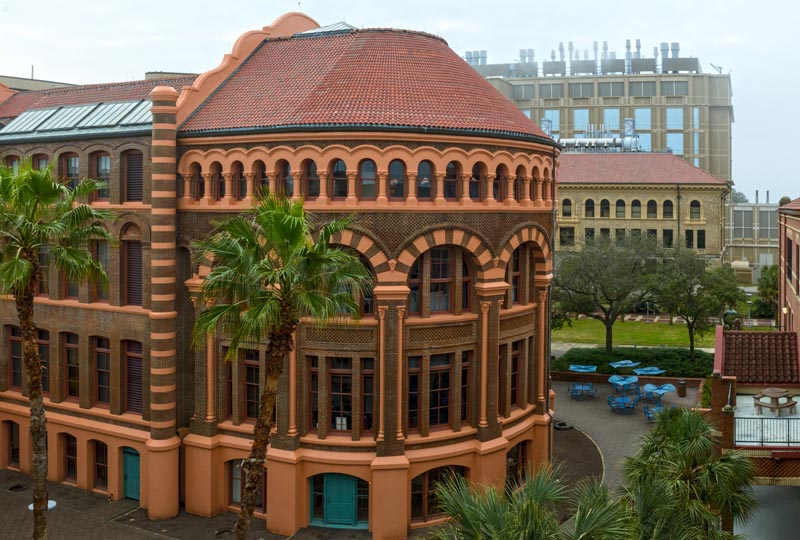
The University of Texas Medical Branch at Galveston (UTMB) is committed to educating a diverse team of health science professionals through its schools of Medicine, Nursing, Allied Health Sciences, and Graduate Biomedical Sciences. The university currently enrolls more than 2,800 students and medical residents. The university also offers a number of distance-education programs for nursing students as well as continuing education courses for practicing health professionals.
Medical research at UTMB informs the educational programs and delves into a broad range of promising topics that often have immediate application to patient care. Areas of research strength include neuroscience and neurological recovery; gastrointestinal health; environmental health and asthma; infectious diseases, biodefense and vaccine development; cancer; molecular medicine, structural biology and proteomics; aging; and diabetes. UTMB also is home to the Institute for the Medical Humanities, the Institute for Human Infections and Immunity, and three World Health Organization Collaborating Centers.
|