|
Galveston is part Southern, part Texan, abloom
with towering oleanders of every color and has
more history and stories than cities 20 times its
size. Part of what is entrancing about Galveston
is that it is so much a town in its own right, and
it always has been. Even today, many residents
refer to is as “The Republic of Galveston Island”
because it is so unlike the rest of Texas.
In 1528, when the first Europeans landed, Galveston Island was home to Akokisa and Karankawa Indians who camped, fished and hunted the swampy land and buried their dead here. The Spanish explorer Cabeza de Vaca was shipwrecked on the Island and lived among the Karankawa for several years as a medicine man and slave. In the late 1600’s, French explorer Robert Cavelier La Salle claimed this area for King Louis and named it St. Louis.
Galveston was named for Bernardo de Gálvez, a Spanish colonial governor and general. Gálvez sent Jose de Evia to chart the Gulf of Mexico from the Texas coast to New Orleans, and on July 23, 1786, de Evia charted an area near the mouth of a river and named it Galveston Bay. Later, the island and city took the same name. Bernardo de Gálvez died the same year, never setting foot on his namesake island.
Hard to Leave the Balinese |
In the smooth swinging era of the ‘40s and ‘50s,
the Balinese Room (formerly located at 2107 Seawall
Blvd.) was legendary as the Gulf Coast’s premier
nightspot. Operated by Sam and Rose Maceo,
the swanky club was situated at the end of a
75-foot pier over the Gulf. Many famous
performers appeared on its celebrated stage –
Frank Sinatra, Tony Bennett, Peggy Lee,
Sophie Tucker, the Marx brothers and Houston
oilmen like Diamond Jim Walker and Glenn
McCarthy were regulars.
The Texas Rangers tried repeatedly to bust
the gambling at the Balinese, but by the time
they’d made their way through the six heavy
glass doors and down the long length of the
pier (dubbed “Ranger Run”), all the gaming
tables had been converted to backgammon,
the slot machines folded into the wall like
Murphy beds, and the chips stashed in the
kitchen (where one suitcase-full was once
inadvertently roasted in the oven). The band
was even known to strike up “The Eyes of
Texas” in “honor” of the Rangers; when all
patrons rose to express their Texan patriotism,
it further slowed the lawmakers’ progress.
The Rangers finally had their way, shutting the Balinese down in 1957,
along with all the other gambling establishments in Galveston. The fabled structure was destroyed during Hurricane Ike, September 2008.
As ZZ Top sang: “Deep in the South
of Texas not so long ago / there on a crowded island in the Gulf
of Mexico…And everybody knows it was hard to leave / And everybody
knows it was down at the Balinese.”
– Ann Walton Sieber 
|
How can you resist a town whose first known
European settler is a pirate? The cultured and
debonair privateer Jean Lafitte established the
colony of Campeche on Galveston Island in 1817,
numbering about 1,000 people at its peak.
Lafitte was eventually forced to leave (burning
his town behind him), and Galveston as we
know it was founded by Michel Menard and
Samuel May Williams, among others. The
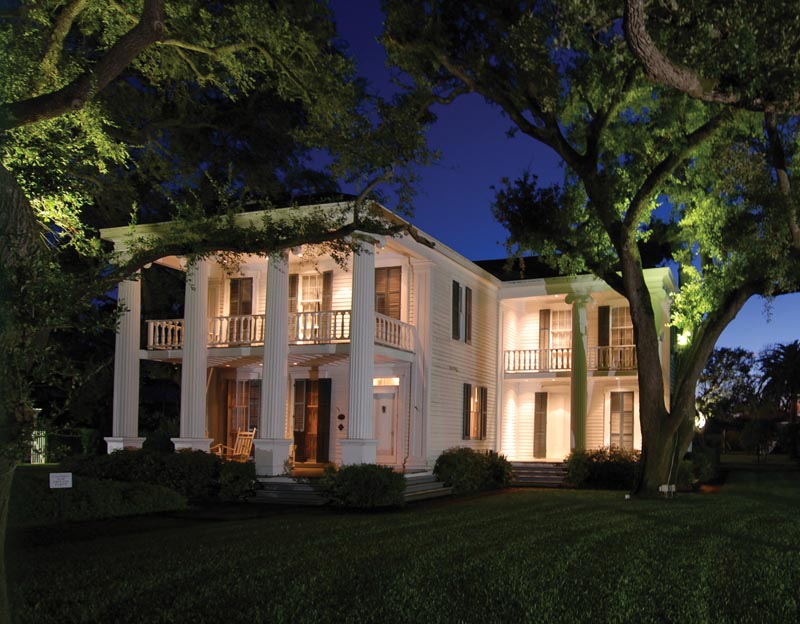
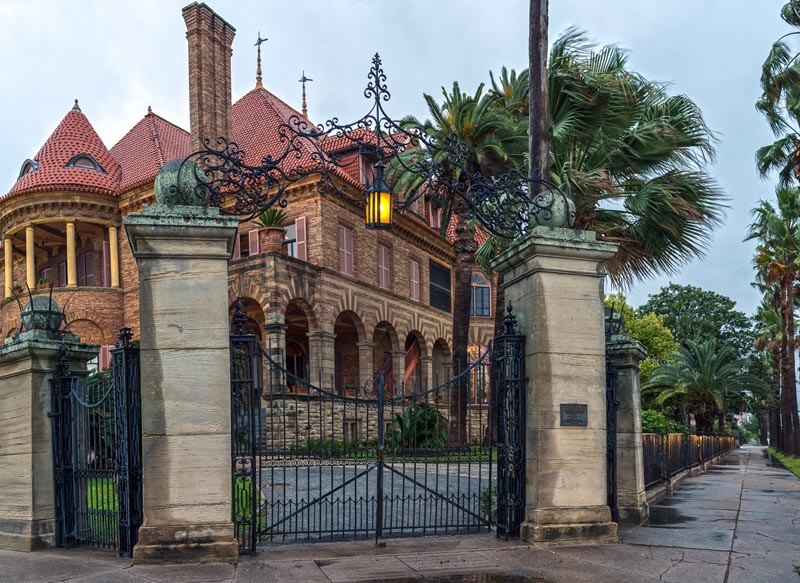
homes of these early island pioneers are still
standing.
Everything is bigger in Texas and in the
nineteenth century, everything in Texas was
done first in Galveston. Incorporated in 1839,
Galveston quickly became the most active port
west of New Orleans and the largest city in the
state. This exciting and sophisticated city built
the state’s first post office, first opera house,
first hospital, first golf course, first country club…the list goes on and on.
However, the flittering town was hit by one “first”
that was devastating: on September 8, 1900,
Galveston was battered by what stands as the most
deadly natural disaster to strike this country,
known 100 years later as the Great Storm. At the time of the 1900 Storm, Galveston had a population of 37,000 and was the fourth largest city in Texas following Houston, Dallas and San Antonio. One-third of the city was completely destroyed, more than 3,600 buildings. More
than 6,000 people were killed - so many, in fact, that the bodies were too numerous for conventional burials. At first, they were weighted and buried at sea; later they washed ashore. From that point on they were burned on funeral pyres all over the city.
The 1900 Storm looms large in the island’s collective memory as
Galveston families pass down stories of survival
and loss. For the complete dramatic story, the film
The Great Storm (shown daily at Pier 21 Theatre in the Strand district) is well worth seeing.
Those who stayed were more determined than
ever to persevere, and they raised the entire level
of the city by eight feet, 17 feet at the Seawall,
slanting the ground so water would run off
into the bay. (Interesting note: The engineer
responsible for this remarkable feat was Henry
Martyn Robert, who also developed Robert’s
Rules of Order.) The grade raising was so
successful that when another hurricane as
ferocious as the 1900 storm swept down on
Galveston in 1915, the city was safe and only
eight people were killed.
However, Galveston never returned to being the
city it once was. Prosperous because of its port,
Galveston commerce was eclipsed when Houston
dug its Ship Channel in 1917. Starting with
Prohibition-era bootlegging, Galveston evolved
into a gambling and drinking resort town.
At the high end was Sam and Rose Maceo’s star-studded Balinese Room, and at the low end were
numerous saloons for wayward sailors. However,
this era came to a dead halt on June 10, 1957
when the Texas Rangers raided the city – serving
injunctions against the gambling joints and yes,
taking axes to the slot machines – ending
gambling in Galveston for good.
The Island languished for years. Then, in the
early ‘80s, Galveston began a campaign of
renewal that has been splendidly successful.
Galveston-born oilman, George Mitchell, led the
revitalization effort, focusing first on overhauling
and promoting the Historic Downtown District,
which contains one of the largest and most
well-preserved concentrations of Victorian
iron-front commercial architecture in the country.
A dedicated team brought the 1877 Tall Ship
ELISSA to Galveston and restored it to its glory
days of full white sails and exquisite wooden
cabinetry: the high-sailing old beauty became
the symbol of the new Galveston.
The excitement building, city leaders next revived
the Mardi Gras celebration by commissioning an
array of the world’s most famous architects to
design fantastical Mardi Gras arches to span the
streets of The Strand district. More than half a
million people now flock to the Island for the city’s
annual Mardi Gras celebration. The Galveston
Historical Foundation went into high gear,
encouraging preservation and restoration and
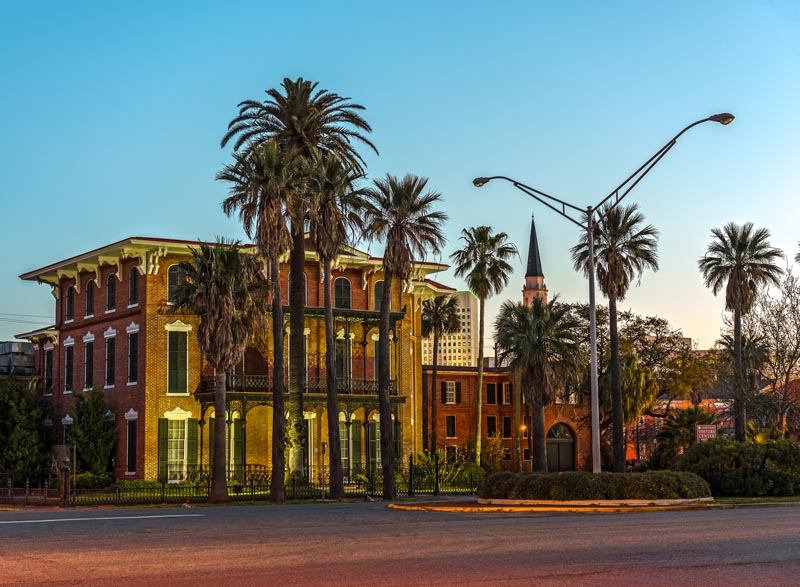
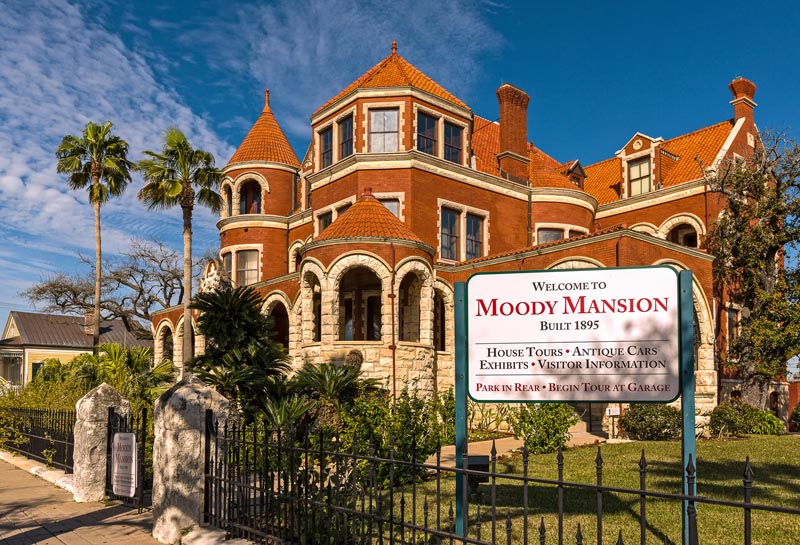
currently more than 2,000 buildings in town are
listed on the National Register of Historic Places.
Tragedy struck once again September 13, 2008, as Hurricane Ike made landfall on the east end of Galveston Island, leaving behind the damage of 100 mph winds and a storm surge estimated between 17 and 20 feet. The Island continues its journey of recovery and rediscovery.

For more information on Galveston Island, please contact the Galveston Island Convention & Visitors Bureau, toll-free at 1-888-GAL-ISLE, or explore our state-of-the-art website, Galveston.com. Also, you may wish to download the Official Galveston Island Visitor Guide by clicking here. Enjoy your visit!

Add Your Comments...
|